Journals
-
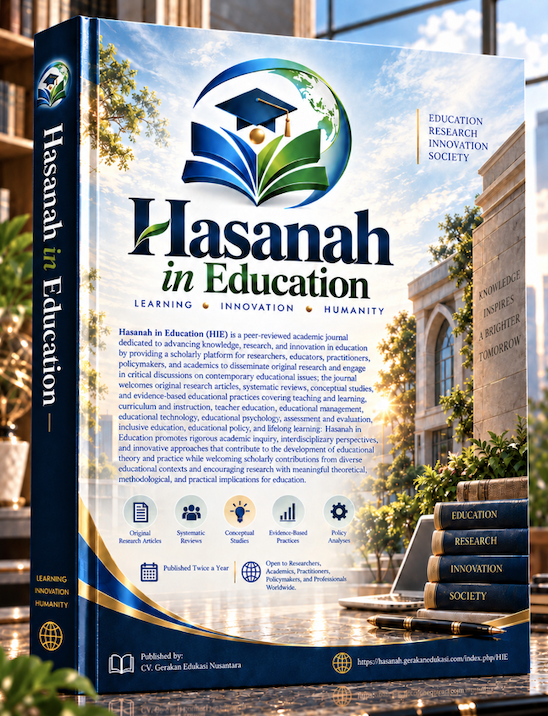
Hasanah in Education
Journal title Hasanah in Education Initials HIE Type of Review Double Blind Review Language English | Indonesia ISSN E-ISSN: XXXX-XXXX Frequency May and November DOI - Editor-in-chief Uswatun Hasanah  |
 |

Publisher CV. Gerasi Insan Nusantara Citation Analysis International Copernicus (ICI) | Google Scholar | BASE(Bielefeld Academic Search Engine) | Garuda | Hasanah in Education (HIE) is a peer-reviewed academic journal dedicated to advancing knowledge, research, and innovation in education. The journal provides a scholarly platform for researchers, educators, practitioners, policymakers, and academics to disseminate original research and engage in critical discussions on contemporary educational issues. Hasanah in Education welcomes original research articles, systematic reviews, conceptual studies, and evidence-based educational practices covering a broad range of topics, including teaching and learning, curriculum and instruction, teacher education, educational management, educational technology, educational psychology, assessment and evaluation, inclusive education, educational policy, and lifelong learning. The journal promotes rigorous academic inquiry, interdisciplinary perspectives, and innovative approaches that contribute to the development of educational theory and practice. It welcomes scholarly contributions from diverse educational contexts and encourages research that offers meaningful theoretical, methodological, and practical implications for education.
-

Hasanah in Law
Journal title Hasanah in Law Initials HIL Type of Review Double Blind Review Language English | Indonesia ISSN E-ISSN: 3165-214x Frequency April and October DOI - Editor-in-chief Muhammad Suthon Aziz | | Publisher CV. Gerasi Insan Nusantara Citation Analysis International Copernicus (ICI) | Google Scholar | BASE(Bielefeld Academic Search Engine) | Garuda | Hasanah in Law is a peer-reviewed academic journal that publishes original and high-quality research covering all areas of law and legal studies. HIL provides a scholarly platform for academics, researchers, legal practitioners, policymakers, and students to disseminate research findings, theoretical studies, conceptual analyses, empirical research, and critical discussions of contemporary legal issues at local, national, regional, and international levels. The journal embraces a broad and inclusive scope of legal disciplines, including Islamic law, civil law, criminal law, constitutional law, administrative law, education law, economic law, business law, commercial law, corporate law, financial and banking law, labor law, family law, international law, environmental law, health law, human rights law, intellectual property law, cyber law, technology law, consumer protection law, tax law, agrarian law, maritime law, and other emerging fields of legal studies. HIL also welcomes interdisciplinary and multidisciplinary studies examining the relationship between law and education, economics, business, politics, society, culture, technology, environment, and public policy. The journal accepts normative, empirical, socio-legal, comparative, historical, philosophical, and interdisciplinary approaches. HIL is committed to promoting academic integrity, methodological rigor, originality, and rigorous peer review. Through the publication of relevant and impactful scholarship, Hasanah in Law aims to contribute to the advancement of legal knowledge, law reform, policy development, legal education, and professional practice.
-
Hasanah in Economics
Journal title Hasanah in Economics Initials HIEC Type of Review Double Blind Review Language English | Indonesia ISSN E-ISSN: 3164-9580 Frequency June and December DOI 10.56404 Editor-in-chief Prof. Dr. Rimi Gusliana Mais, S.E., M.Si., CSRS., CSRA. | | Publisher CV. Gerasi Insan Nusantara Citation Analysis International Copernicus (ICI) | Google Scholar | BASE(Bielefeld Academic Search Engine) | Garuda | Hasanah in Economics (HIEC) is a peer-reviewed academic journal that publishes original, rigorous, and high-quality research covering all areas of economics and economic studies. HIEC provides a scholarly platform for academics, researchers, economists, practitioners, policymakers, business professionals, and students to disseminate research findings, theoretical studies, conceptual analyses, empirical research, and critical discussions of contemporary economic issues at local, national, regional, and international levels. The journal embraces a broad and inclusive scope of economic disciplines, including Islamic economics, microeconomics, macroeconomics, international economics, development economics, monetary economics, fiscal economics, public economics, financial economics, banking, Islamic banking and finance, business economics, managerial economics, behavioral economics, labor economics, agricultural economics, environmental economics, regional economics, industrial economics, digital economics, creative economics, entrepreneurship, halal economics, sustainable economics, and other emerging fields of economic studies. HIEC also welcomes interdisciplinary and multidisciplinary studies examining the relationship between economics and business, finance, Islamic studies, law, education, politics, society, culture, technology, environment, sustainability, and public policy. The journal accepts theoretical, empirical, quantitative, qualitative, comparative, historical, experimental, and interdisciplinary approaches. HIEC is committed to promoting academic integrity, methodological rigor, originality, relevance, and rigorous peer review. Through the publication of relevant and impactful scholarship, Hasanah in Economics aims to contribute to the advancement of economic knowledge, innovative economic thought, evidence-based policymaking, sustainable development, inclusive prosperity, and the improvement of economic and financial practices in the global community.